Claude vs ChatGPT vs Gemini: Which AI Is Best for…
Claude vs ChatGPT vs Gemini: Which AI Is Best for Marketing in 2026? Lorem ipsum dolor sit amet, consectetur adipiscing…

Home » Why Everyone Is Talking About Comet Sneakers: A Marketing Breakdown
Lorem ipsum dolor sit amet, consectetur adipiscing elit. Ut elit tellus, luctus nec ullamcorper mattis, pulvinar dapibus leo.
TL;DR:
Comet sneakers are everywhere right now: on Instagram, in YouTube unboxings, sneaker groups, and even on your friend’s WhatsApp status. No big celebrity face. No huge TV budget. We run a marketing agency, so we dug deep into how Comet actually markets itself, including what founder Utkarsh Gupta said on the Think School podcast (“Laws of Hype Creation”).
Comet did something different. Instead of spending crores on Bollywood stars or cricketers, they skipped celebrity endorsements completely. They also avoided paying big influencers just to promote their sneakers.
When Comet launched, they had:
So, what did they do instead?
They sent free sneaker pairs to real sneaker lovers, fashion creators, and athletes who genuinely enjoy sneakers. These creators wore the shoes because they liked them, not because they were forced to by a brand deal.
As a result, people started posting unboxing videos, outfit reels, and honest reviews on their own. The content felt natural and authentic, not like a paid advertisement. Founder Utkarsh Gupta also shared this on the Think School podcast. Instead of buying attention, Comet focused on earning trust. This strategy takes more time, but it creates something much stronger. When people see real sneaker fans recommending a product, they trust it more than a celebrity promotion.
Here’s the part that’s easy to miss. Every global sneaker brand, Nike and Adidas, built their image around Western sneaker culture: basketball courts, skateboarding, and hip-hop. It’s the default “cool sneaker” visual everyone copies.
Comet understood one simple thing. Sneaker culture in India is very different from the US. We didn’t grow up with basketball courts or skate parks like people in America did. So copying that style would have felt fake. Instead, Comet built a brand that feels familiar to Indian youth.
Their content is inspired by things we all grew up with: mangoes, ice golas, laddis (firecrackers), matchboxes, and even an orange being peeled by your grandmother. These aren’t random objects. They’re memories that instantly connect with people.
That’s what makes Comet stand out. Instead of copying Western sneaker brands, they created a brand that feels proudly Indian. And when people see something that reminds them of their own childhood, they connect with it naturally.
Comet’s Instagram doesn’t rely on catchy captions. It relies on the product itself having something worth filming.
Neither of these needed an ad explaining “why this is cool.” The product does that job. People pick it up, discover the trick themselves, and film it without being asked to.
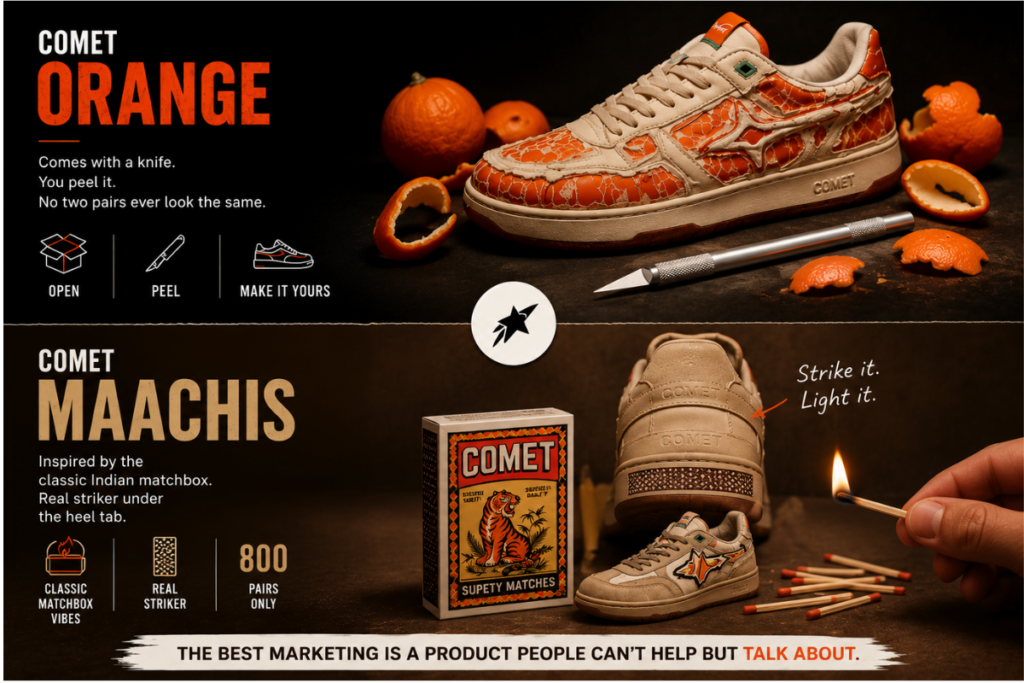
Neither of these needed an ad explaining “why this is cool.” The product does that job. People pick it up, discover the trick themselves, and film it without being asked to.
A lot of brands write “hurry, only a few left” on every product page, even when it’s not true. Comet’s scarcity is real; a drop like Maachis really was capped at 800 pairs with no restock. When the stock is genuinely limited, people talk about missing it, which keeps the brand relevant even for the people who didn’t buy it.
On the Think School podcast, Utkarsh explained that Comet built demand from zero, with no big marketplace and no big distributor helping them. They deliberately stayed off Myntra for two and a half years, choosing to sell only through their own website first. This lets them read every customer comment directly and shape the brand around real reactions, instead of just chasing volume on a marketplace. That patience paid off; Comet now sells around 25,000 pairs a month and only went on Myntra once the brand was already strong on its own.
Usual Sneaker Brand | Comet | |
|---|---|---|
Face of the brand | Celebrity or big athlete | No celebrity at all |
Influencer strategy | Pay big influencers for posts | Gift product to real sneakerheads who post on their own |
Visual style | Basketball, skateboarding, hip-hop | Everyday Indian objects mango, matchbox, orange |
What sells the shoe | The ad campaign | The product’s own “discover it yourself” moment |
Scarcity | Fake urgency banners | Real limited runs, no restocks |
Where they sell first | Big marketplaces from day one | Own website first, marketplace much later |
This kind of thinking, finding the one honest idea a brand can build everything around, is exactly what we do at Chai Media.
Comet didn’t get famous with ad spend; it got famous by giving people something worth filming and letting real fans do the rest. That’s the kind of strategy we build for our clients at Chai Media.
📩 Reach out to Chai Media for a free marketing audit, and let’s find your brand’s own “Maachis moment.”
Digital Marketer & SEO Specialist

Sharing ideas, strategies, and real experiences from the world of SEO, content marketing, AI,and digital growth.
SEO • Content Marketing • AI Marketing • Meta Ads
📩 FREE DAILY
No spam. Unsubscribe anytime.

Claude vs ChatGPT vs Gemini: Which AI Is Best for Marketing in 2026? Lorem ipsum dolor sit amet, consectetur adipiscing…
Your Logo Isn’t the Problem; Your Brand Positioning Is Lorem ipsum dolor sit amet, consectetur adipiscing elit. Ut elit tellus,…
The Biggest Marketing Trends Every Startup Has to Watch in 2026 Lorem ipsum dolor sit amet, consectetur adipiscing elit. Ut…